The Super Bowl is supposed to be the NFL’s grand spectacle. This year, at least on the field, it felt more like a slog. The Seattle Seahawks defeated the New England Patriots 29-13 in Super Bowl LX, storming ahead early and never letting the Patriots recover.
Sophomore Shepherd H.* summed up the night with humor.
“I watched the Super Bowl this year to watch Drake Maye cook… he did not,” Shepherd said.
Although the game failed to excite, the halftime show did the opposite. Bad Bunny’s performance quickly became the night’s biggest moment and later became the most-streamed Super Bowl halftime show in history.
Benito Antonio Martínez Ocasio, who goes by the stage name Bad Bunny, entered the performance at the peak of global influence. The Puerto Rican artist has spent the past several years dominating Billboard streaming charts, selling out stadium tours across multiple continents and pushing Spanish-language music deeper into the American mainstream. His dominance was underscored by the runaway success of “DeBÍ TiRAR MáS FOToS,” which shattered streaming records and earned him album of the year at the 2026 Grammys, a milestone never before achieved by a primarily non-English-language artist. By multiple industry measures, he ranks among the most listened-to artists in the world.
That scale helps explain why the NFL selected him. Senior Irene K.* emphasized that his booking reflected more than just representation.
“I think he was a great choice for the halftime show. Having him perform alone is a cultural moment. He is not just ‘a Latin artist.’ He’s one of the biggest artists in the world and his Spanish language albums are dominating global charts,” Irene said.
The halftime show has increasingly become a vehicle for expanding the league’s cultural reach, and Bad Bunny brings one of the largest and youngest fan bases in global music.
His performance also included a brief but widely discussed crossover moment: a salsa-infused segment of “Die With a Smile” featuring Lady Gaga. The stylistic pivot blended Latin rhythm with mainstream pop, reinforcing the show’s cross-cultural ambition and giving the set one of its most talked-about transitions.
Reactions to the performance were positive, though not uniform.
Senior Avalon B.* described the show as “powerful” and emphasized the artist’s controlled confidence.
“He has such a strong stage presence without even trying too hard,” Avalon said. “The energy, the visuals, the dancers, everything felt very him and very intentional.”
Junior Pamela D.* said the performance resonated with her because many of the background details reflected experiences she grew up with. She pointed to a moment where a child lay across two chairs, saying it reminded her of attending late family parties as a kid and making “a makeshift bed” out of nearby chairs when she got tired.
Senior Fernanda P.,* who said she does not typically follow Bad Bunny, still found the production meaningful.
“I noticed he added a lot of cultural elements from Latin America. I thought many of the references or inside jokes were nice, like the kid sleeping on the party chairs, the nail artists gossiping, the elders on stage and the agua de pipa (coconut water),” Fernanda said.
Shepherd, while less personally enthusiastic about the music, still framed the choice as logical rather than controversial.
“His music isn’t my style… but he’s extremely popular with the younger generation and it helped pull in a different audience, which is always a good thing to extend reach,” Shepherd said.
One of the loudest moments came during the performance of “DtMF,” when the entire stadium sang along in Spanish, with thousands of fans shouting the lyrics back toward the stage. Avalon said that moment stood out the most to her.
“Seeing that many people in the U.S. singing along in Spanish felt like such an important cultural moment,” Avalon said.
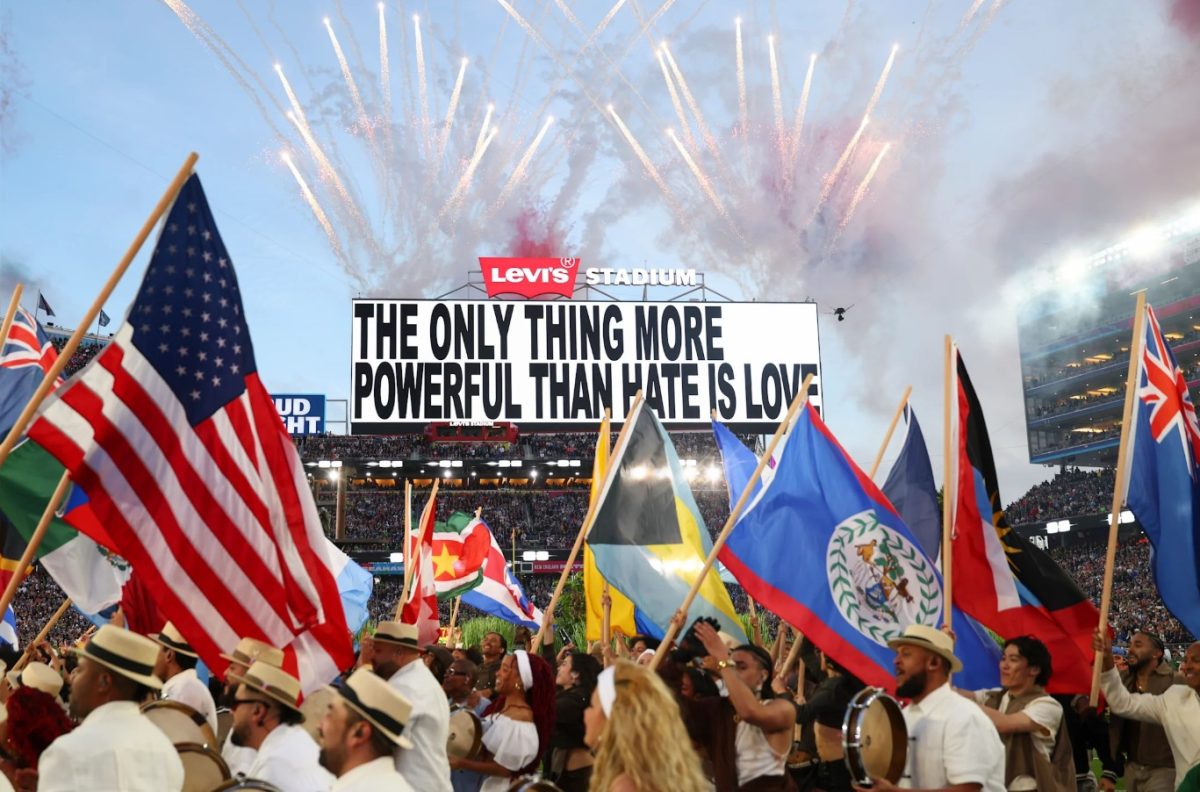
Toward the end of his set, Bad Bunny listed out the names of several countries in North, Central, and South America, displaying a football that said “Together, We Are America,” as other performers waved the flags of those countries. Several students found this to be a nice touch that emphasized his message of unity.
Senior Bijai S.,* who is from the Dominican Republic, said the flag moment stood out to him.
“The moment from the halftime show that stood out the most to me was when Bad Bunny brought out all the flags of the Latin countries, especially when he brought out the Dominican flag,” Bijai said.
Fernanda, who is from Panama, also pointed to the flag moment, echoing Bijai’s reaction.
“I fully wasn’t expecting him to mention all the countries in the American continent. That was both nice and ironic. The fact that it was a statement made on an ‘American’ show was pretty funny to see.” Fernanda said.
The show concluded with a billboard-style message displayed across the stadium screens that read, “The only thing more powerful than hate is love.”
Irene pointed to the show’s closing message as the most memorable moment.
“Definitely the end where the message ‘The only thing more powerful than hate is love.’ was written,” Irene said. “It’s a message that is very much needed at this time in our world.”
Together, those moments captured the performance’s broader message. Rather than anglicizing the show for a traditional Super Bowl audience, Bad Bunny leaned into Spanish lyrics, Latin visual motifs and Pan-American identity. In many ways, the moment reflects a longer arc in pop history. Earlier Puerto Rican global stars like Ricky Martin helped pave the way for Latin artists in the U.S. mainstream during the late 1990s Latin pop boom. Reporting from the era shows that many of those artists still faced heavier scrutiny about language, identity and crossover appeal as they crossed into the U.S. market. Bad Bunny, by contrast, arrived on the Super Bowl stage with Spanish-language dominance already normalized, suggesting how much the cultural landscape has shifted.
Students widely recognized the representation angle. Irene argued the performance matched broader cultural reality.
“Cultures are meant to be shared, appreciated and celebrated. Having him perform was an acknowledgment of impact. I also think what was beautiful was how music brings people together,” Irene said.
Avalon said Bad Bunny’s performance “proves that culture in the U.S. is way more diverse than people want to admit.” Pamela similarly emphasized “how massive [the] spread [of] Latin culture has gotten.” Junior Maxim D.* said the moment shows the country is “diverse and tries to include everyone.”
Where opinions diverged most was on whether halftime shows should carry deeper messaging. Avalon strongly supported artists using the platform for awareness.
“When you have a stage that reaches millions of people across the world it should be used to spread awareness,” she said.
Pamela took a middle-ground stance, saying it is appropriate “as long as they are respectful and meaningful.” Maxim agreed that such messaging can be positive when it is “kind and morally just” because “it brings people together.”
Shepherd preferred a more entertainment-focused approach, emphasizing audience fatigue rather than opposition.
“My lord, with how divided the country is, in my non-expert opinion, people get riled up for anything political – just keep it entertaining, that’s your job as an entertainer,” he said.
Bijai expressed mixed feelings.
“On one end I think the political message… [was] very good and powerful,” he said. “However, on another end, people go to the Super Bowl to get away from political issues worldwide so a political message might make them uncomfortable.”
Irene pushed back on the idea that halftime shows should avoid meaning altogether.
“Art reflects culture…The halftime show is one of the most popular performances in the country and I think expecting it to be totally neutral is unrealistic. It can be both fun and meaningful. Those are usually the moments that people remember years later,” Irene said.
Super Bowl LX may not be remembered for on-field fireworks, but it will be remembered for what it revealed about the country watching it. The halftime stage became a portrait of America as it actually exists: multilingual, multicultural and constantly evolving. Bad Bunny is the reflection of a generation for whom Spanish, English, Latin rhythms and American pop culture all coexist in the same identity. In that moment, the Super Bowl did not just showcase a global artist. It showcased an honest version of America itself.
*Last names withdrawn for student privacy, per school policy.