When I enrolled in AP U.S. Government and Politics at the beginning of the year, I expected a simple introductory class on the structure of the United States government and the functions of its political system. However, I didn’t anticipate the valuable political insight and academic excellence I would gain from this course. As the semester progressed, I was pleasantly surprised to find that it had become my favorite class, continually keeping me engaged and eager to learn.
The course guided students through landmarks in America’s political history, from the nation’s founding to the 21st century. GWUOHS history department lead Daniel Kelly, who teaches the course, held weekly live classes, covering each week’s content with detailed slideshows, engaging discussions, and guidance on assignments and AP exam-specific requirements.
Having completed this course, I’ve found that it offers students two principal benefits: It enables students to establish a foundation in U.S. politics – essential for understanding past and current political affairs – and to develop practical skills that strengthen academic performance.
The first benefit I gained from this course, and the one I noticed immediately, was the new insight it provided in understanding current political news and affairs.
For instance, a month into the school year, the U.S. federal government shut down for 43 days due to Congress’s failure to pass a funding plan for the 2026 fiscal year. This resulted in the furlough of 1.4 million federal employees and exemplified the gridlock that often hinders the legislative process and delays the approval of critical policies.
In class, we learned that 60 votes are necessary to pass an appropriations bill in the Senate. The Republican Party, holding 53 seats in the Senate, failed to acquire the minimum number of votes to pass the bill. After more than a month of shutdown, the Senate voted 60-40 in favor of a new funding plan, and a compromise was reached.
Taking AP U.S. Government and Politics, I understood this bipartisan issue within the greater context of the legislative process and conflicting party demands.
A couple of months later, the Supreme Court granted a writ of certiorari before judgment in Trump v. Barbara, a case challenging the constitutionality of President Donald Trump’s executive order, “Protecting the Meaning and Value of American Citizenship,” under the Citizenship Clause of the 14th Amendment.
In studying the judicial branch of the U.S. government, I learned that a writ of certiorari granted by the Supreme Court allows it to hear cases appealed from lower federal courts or state supreme courts. The Supreme Court can then evaluate the constitutionality of legislation and executive actions through its power of judicial review (a role established by the landmark 1803 case, Marbury v. Madison).
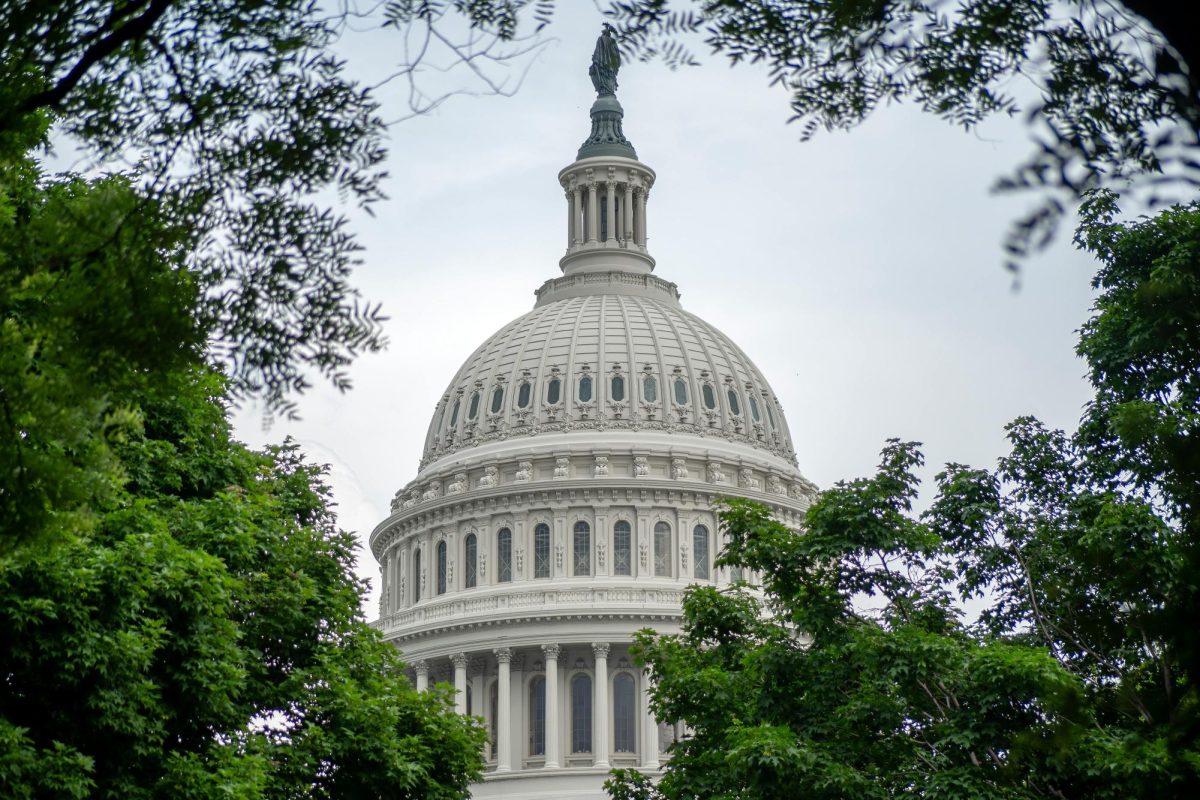
A few months before taking the course, the words furlough, gridlock, and writ of certiorari would have painted a blurry picture in my mind’s eye of a government building with Greek columns and politicians arguing throughout the day. Yet, having studied these concepts and their roles in the political process, I was able to understand these headlines and their political implications.
Thus, the beauty of understanding politics and government through a comprehensive course is that it brings that vague, opaque picture into focus, allowing one to observe the workings of the political system through a crystal-clear lens.
Senior Nikhil N. remarked on his surprise at certain aspects of the course material.
“I didn’t expect to spend so much time on things like the iron triangle and bureaucracies…but it was very enlightening,” he said. “It’s also been useful to understand what elections are actually made of in America.”
Affirming my own experience, Nikhil expressed that the “course has definitely met and exceeded [his] expectations for AP Gov,” as it was firmly “rooted in real scenarios, and [he] felt empowered to extrapolate concepts to other similar scenarios.”
Junior Esme B. stated that the course also met her expectations, and that she “was surprised by how the course went in-depth into topics on which [she had] only touched the surface, while also keeping it simple at the same time.”
In addition to helping me better understand current events, this course also improved my skills in note-taking, argumentative writing, summarizing long chapters, and keeping up with fast-paced content. Each major topic was covered in one to three chapters in the textbook, and Kelly’s live sessions were structured around the majority of each week’s content. His extensive presentations and class lectures served as a valuable introduction to higher-level academic learning.
Esme noted that the course encouraged her to improve “retention and note-taking skills,” and Nikhil shared that he gained “stronger analytical and argumentative skills, especially when evaluating Supreme Court cases, legislation, and political claims.”
Nikhil stated that the course encouraged him “to support arguments with evidence, evaluate opposing viewpoints, and think more structurally about problems.” He added that “those skills have also carried over to [his] written and debate work.”
One of my favorite components of this course was studying landmark U.S. Supreme Court cases. We learned to analyze the reasoning of Supreme Court justices and understand the constitutional significance of the rulings. Studying case details truly brought to life the Constitution’s primary function – protecting the rights of American citizens and ensuring a just political system.
The test at the end of each unit was based on AP exam format free-response questions (FRQs), prompting us to apply critical thinking and argumentative skills. In addition, note-taking during class sessions offered a unique opportunity to practice distilling complex ideas into key points.
The faster pace of this one-semester course drove students to optimize learning strategies and develop productive study habits that maximize retention and learning. As an AP course, the content was structured according to the College Board outline, and the class prepared its students for the AP exam.
While students chose to take this course for a variety of reasons, we all shared a curiosity and interest in U.S. government and politics. Nikhil’s decision to take the course was tied to his intentions “to study political science and economics in college,” as well as his interest in global affairs and politics, while Esme chose to take AP U.S. Government and Politics because of the joy she finds in “learning history…with its nuances and details.”
“Let the thirteen States, bound together in a strict and indissoluble Union, concur in erecting one great American system…” concluded Alexander Hamilton in “Federalist No. 11″ in 1787 (as any AP U.S. Government and Politics student would know, it’s hard to resist quoting “The Federalist Papers”).
To use Hamilton’s phrasing, this course’s principal value lies in its ability to provide a broad overview of the structure and intricacies of the “great American system” – its strengths, weaknesses, flaws, and accomplishments – offering students an essential foundation for political understanding and a practical skillset for academic excellence.