Two years ago, I spent spring break in Mexico City. Over a few warm days, my family and I delighted in exploring the city, walking through purple jacaranda-lined streets, taking in the historic architecture, and meandering in and out of vintage record stores and second-hand book shops.
At the end of our trip, I wandered into the hotel gift shop where a silver watch caught my eye. It had a bracelet band and a small, oval, cream-colored face. The band was made of delicate, rectangular links connected by dainty gems, and a thick silver frame surrounded the face.
I loved it immediately. When I paid for it, the lady at the counter smiled at me and said, “It is real silver, both valuable and beautiful.”
The watch was, indeed, beautiful, and I have worn it regularly since then, but earlier this year, I discovered the deeper truth in her statement – that the underlying value of the watch lies in its silver.
A few months ago, I came across a New York Times article describing a historic surge in the silver price. Since the start of 2025, the price of silver more than quadrupled, beginning the year at $29/oz and reaching an all-time high above $121/oz in February 2026.
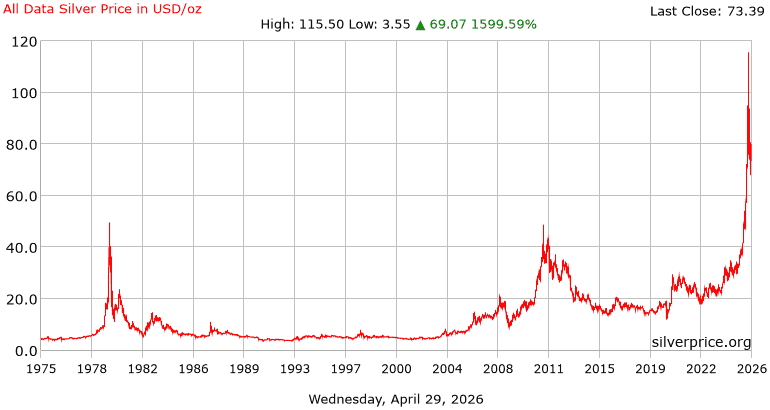
The dramatic breakout in the silver price intrigued me, and I decided to look into the reasons behind this trend. I found that four major forces are driving the price of silver, making it one of the most interesting and closely watched commodities in the world.
These forces are: monetary uncertainty, geopolitical tensions, rising industrial demand, and unique silver mining constraints.
The global financial system is currently facing new pressures and instability. While the U.S. dollar remains the global reserve currency, many countries are diversifying into hard assets such as gold and silver as alternative stores of value. Concerns over the growing U.S. debt and the long-term stability of the dollar have driven both investors and governments to recognize the value in holding precious metals.
This increasing investment in silver is often considered through the lens of Gresham’s Law, which states that “bad money drives out good money.” The law implies that in an economy where two currencies are accepted at the same face value, people will tend to spend the one with less intrinsic value and hoard the more valuable one.
But why are precious metals considered “good” money? Their intrinsic value is derived from their scarcity, as well as the energy – whether human or mechanical – expended to extract them from the earth. Precious metals also possess the six qualities that characterize money: durability, divisibility, portability, uniformity, acceptability, and scarcity.
When confidence in government-issued fiat currencies (not backed by precious metals) wanes, people tend to store or hoard assets of intrinsic value, which partially explains the trend of rising silver investment.
On an international level, following the freezing of roughly $300 billion in Russian central bank assets after the outbreak of the Russo-Ukrainian war, Russia moved toward diversifying its assets into physical commodities, including silver, gold, platinum, and palladium.
In India and China, households invest in gold and silver as a form of savings, and the governments are increasingly recognizing this and responding through policy. India is estimated to have imported $9.2 billion worth of silver last year, a 44% increase from the previous year, despite the sharply rising prices, while China, which controls around 70% of global silver refining, introduced export controls that restrict the export of refined silver.
Industrial demand is yet another significant factor driving the silver price higher. Unlike gold, which is primarily used for investment purposes, silver is heavily utilized in industry. Its unique electrical conductivity makes it an ideal material for high-tech applications.
Approximately 58% of global silver demand is attributed to industrial applications in solar technology, AI, electronics, electric vehicles, batteries, and even anti-bacterial medical instruments. In military and aerospace applications, silver is found in radar, guidance, and communications systems, as well as in sensors and optics.
It’s also interesting to note the unique challenges of silver mining. Silver is extracted primarily as a byproduct of copper, lead, zinc, and gold mining. As a result, silver supply is inelastic – even with considerably higher prices, its supply won’t increase easily.
This year marks the sixth consecutive year of silver deficits, meaning global demand is outpacing supply. Analysts suggest that the global silver supply deficit is being further driven by declining silver production in the largest silver-producing countries: China, Mexico, and Peru. Also, the price of silver has historically been too low to incentivize new production since mining companies face rising costs of energy, labor, and equipment. As silver is now breaking out of its previous price ceiling, one point is evident: silver supply cannot easily increase to match rapidly rising demand.
Silver is clearly becoming an increasingly valuable asset. As both a monetary and industrial metal, it is emerging as a star player in the shifting global economy.
Spring break greets us again this semester, a reminder of how far we’ve come and how much we’ve grown. Little did I know, this past year, my silver watch was also growing — in value!